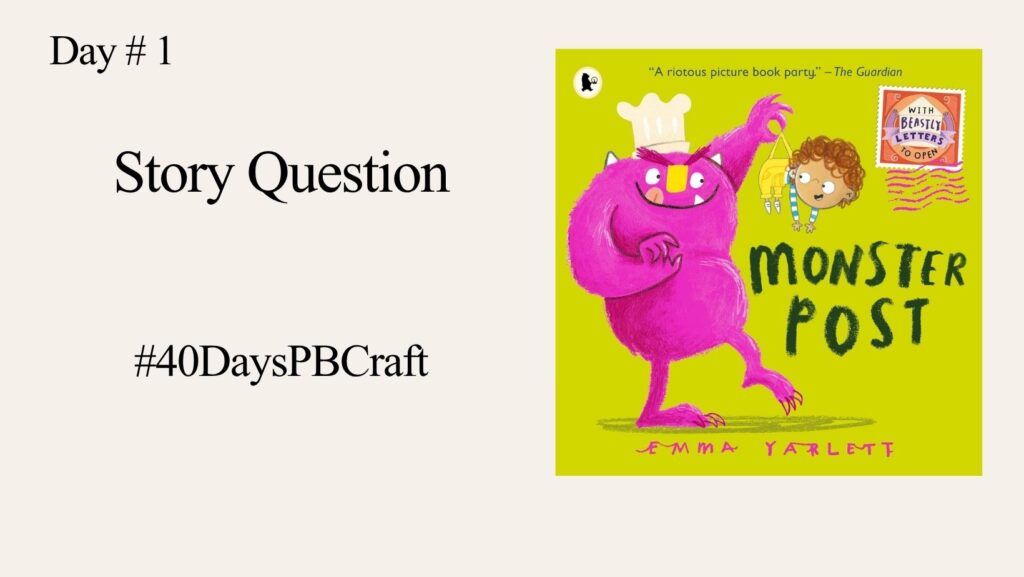
Welcome to day 1 of 40 craft lessons from 40 picture books.
All well-crafted stories share one essential element. Whether it’s 32 pages or 300, readers keep turning the page because of it.
In Monster Post, a beast finds a delicious-looking dinner: a child. The beast writes to his monster friends, inviting them to a feast, and each reply arrives as an interactive letter the reader can open. Each monster wishes for a new ingredient in the meal.
The story is funny, the design inventive. But when I first read this book, I didn’t turn the page for the following letter or the illustrations. I turned it because I had to know:
Would the child survive?
The story question is more than “What happens next?” Those are stepping stones, scene to scene. The story question is the overarching bridge tension that fuels the story’s engine. No matter the genre or age group, every story should keep its readers hungry for the answer.
The challenge is that the story question must arise organically from the story. It should emerge from the character’s goals and the story’s internal logic, not from manipulation or misdirection. Readers may forgive plot mistakes, but they don’t forgive feeling tricked.
Without a story question, the story becomes a sequence of “this happened, then that happened.” Events may be amusing, but without deeper tension tying them together, the reader soon loses interest. Why should a simple chain of events matter?
A compelling story keeps the answer to the story question for the final page or chapter. If the answer is given away sooner, the story’s engine runs out of fuel.
In Monster Post, as the date of the party approaches, the tension rises. The monster dutifully adds each strange, bizarre ingredient to the dinner. At the climax, the guests arrive. Now, you see the story question at full power: Will the monsters eat the child? The final page delivers a thematic message and the answer the reader has been waiting for.
I hope reading this blog post has given you new ideas. See you tomorrow for Day 2. If you would like to read these 40 craft lessons on WhatsApp, please join the channel.
More blog posts on picture book craft are available on PictureBookPedia.
Thank you for the post Nakisa! Could you give an example for this point (manipulation or misdirection part) , of course if you have time: the story question must arise organically from the story. It should emerge from the character’s goals and the story’s internal logic, not from manipulation or misdirection.
There are examples of plot contrivances that writers use to heighten the story question. For example, a child searches for her lost toy before bedtime. The story question is “Will she find the toy?” The character searches for the toy everywhere, and just when she is losing hope, a star starts to speak and tells her where the toy is. This is a plot contrivance. You see examples in adult books and children’s books, but I’m not referring to any particular book negatively.
This is a wonderful explanation and example. Thank you so much for sharing.