Welcome to day 33 of 40 craft lessons.
The fantasy genre is defined by magic or supernatural elements and forces. Dragons, unicorns, elves, and wizards have populated this genre so extensively that it might seem impossible to write a fresh fantasy story. Still, many magical creatures can carry our imaginations into a fantasy world.
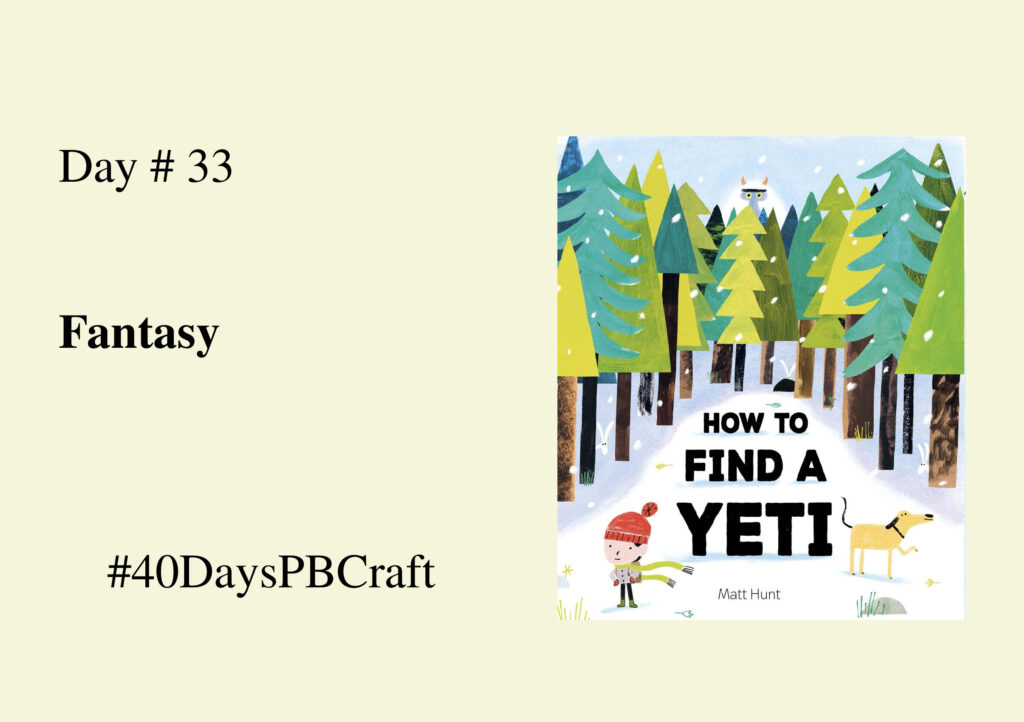
How to Find a Yeti is the story of a boy who firmly believes that Yetis exist and, more importantly, that he is a professional yeti finder. The boy and his dog, Milo, go on a mission to find a yeti. When I started reading the book, I immediately wanted to know whether the boy would find a yeti or not. This is the power of a strong story question.
The story has a touch of humor. The reader can spot the yeti in the illustrations. Even the dog notices the yeti. Only the professional yeti finder does not see it. This is a fantastic way to involve the reader in the story; the reader has more access to the story world than the main character!
At the end, the boy and his dog return home with no success, but that is not the end. The boy remembers that he forgot his scarf and decides to go back into the woods again the next day. And this is not the end either. The story has another twist at its conclusion.
The important point is that magical creatures are wonderful raw material for building a story world. However, their sense of wonder alone is not enough to hook the reader. A story still needs narrative elements to remain cohesive. Without narrative structure, a story question, and stakes, a fantasy setting remains merely a setting—not a story.
Hope reading this blog post has given you new ideas. See you tomorrow for Day 34.