Welcome to day 31 of 40 craft lessons.
Informational fictions, as the genre name says, are stories with the main purpose of conveying information and facts.
One of the most frequently used literary devices in this kind of fiction is anthropomorphism. This literary device assigns human characteristics, emotions, and behaviors to nonhuman entities, such as animals or inanimate objects. This helps bring the young reader closer to the subject.
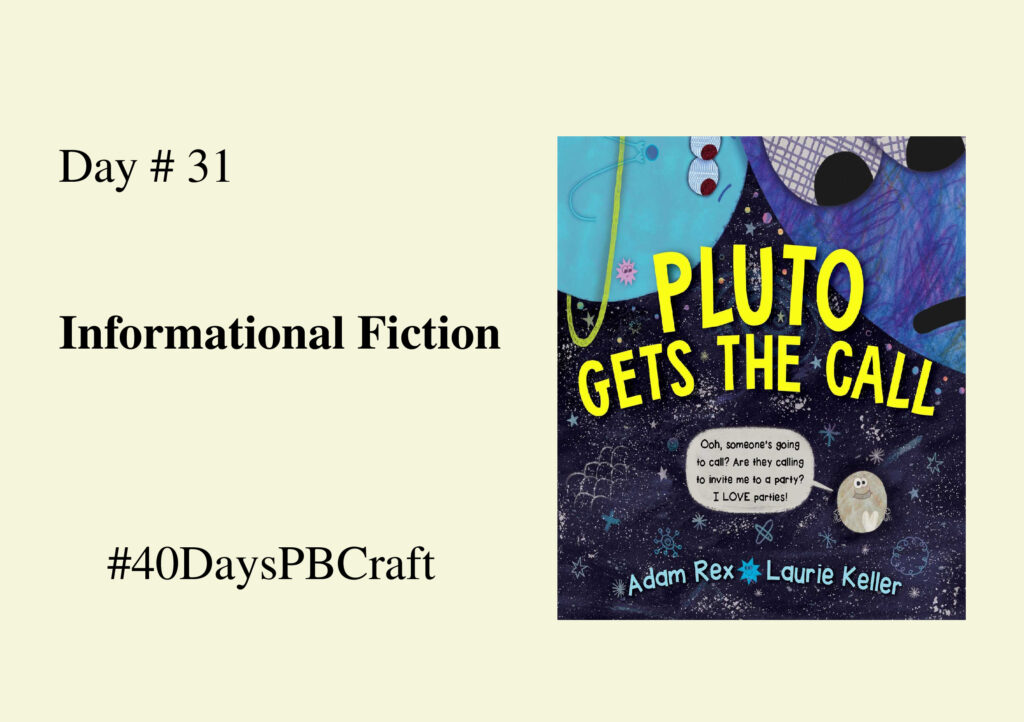
In Pluto Gets the Call (2019, Adam Rex, Laurie Keller), the planet Pluto gets a phone call from a scientist on Earth. Very sad news: Pluto isn’t a planet anymore. We see human characteristics. First, Pluto gets the call; then a wave of human feelings devours him: anger, humiliation, and the need to ask for help from other planets.
First, let’s consider the narrative structure. The inciting incident is when Pluto gets the call. Pluto’s calls with other planets make up the middle of the story. The last part of the narration, the end, is when talking with the Sun helps Pluto look at the situation from a different perspective. Then, observe the emotional journey of the character (Pluto), from receiving sad news, to accepting it, to perceiving it differently.
You see how wonderfully this story brings science to the young reader. Compare it with a dry list of facts. This is the power of storytelling.
Hint: Informational fictions are NOT biographies or memoirs because they feature fictitious characters with made-up dialogue, unlike narrative non-fiction.
Hint: Informational fictions are NOT science fiction (sci-fi). Science fiction typically deals with futuristic concepts such as advanced science and technology, space exploration, etc.
Hope reading this blog post has given you new ideas. See you tomorrow for Day 32.