Welcome to day 30 of 40 craft lessons.
Biography is one of the most common genres in picture books, and its evolution is interesting to watch.
If you look back at books published before 2015, you’ll often see long blocks of text paired with fairly simple illustrations. Between 2015 and 2020, things began to shift. Illustrations became more expressive and artistic, while the text grew shorter and more intentional. Then, after the COVID-19 pandemic, another noticeable change emerged: the language itself. Texts became more lyrical, and page designs felt bolder and more thoughtfully composed.
Picture book biographies play a powerful role in introducing young readers to people they might never otherwise encounter. Yet truly compelling picture book biographies are surprisingly not abundant. And that’s understandable—turning a real person’s life into a strong, engaging story is no easy task.
Some biographies read like timelines: this happened, then that happened—which is description, not a story. Others overwhelm readers with info-dumps. And many skip over the struggle entirely—the character decides to become a scientist (or an artist, or an activist), and then, they are one. Without obstacles, though, there’s little story for young readers to hold onto. As the old storytelling motto goes: no conflict, no story.
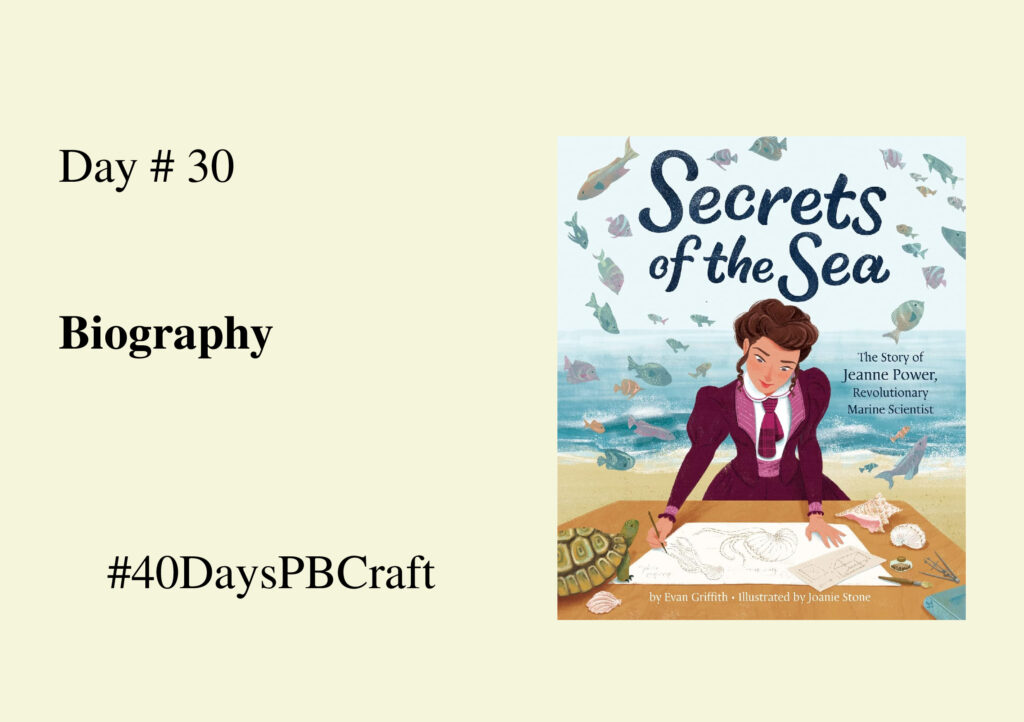
Secrets of the Sea (2021, Evan Griffith, Joanie Stone) is a superb example to learn from. This biography of Jeanne Power, a revolutionary marine scientist, begins at a moment of disruption. After she marries, Jeanne can no longer continue her work as a seamstress, and she finds herself uncertain and confused. Right away, we see the first lesson in character-building: start with a flawed, struggling character.
The story shows how Jeanne does her best to pursue her studies of sea creatures—and the obstacles she faces along the way. The ship carrying her research sinks. She receives discouraging feedback from a male-dominated society. These challenges don’t just add tension; they give the story its emotional weight. They show that the character has earned her success—it is not bestowed on her, nor simply a matter of talent.
The word count may be higher than what today’s market typically favors, but the book’s storytelling still has a great deal to teach us.
Hope reading this blog post has given you new ideas. See you tomorrow for Day 31.