Welcome to day 29 of 40 craft lessons.
Writing a picture book memoir isn’t for every writer—not every life has a story. But reading picture book memoirs benefits any writer, since it helps with one of the most difficult steps in writing picture books: deciding what to include and what to exclude.
Studying memoirs also teaches us how to intertwine difficult topics like immigration and political turmoil in picture books.
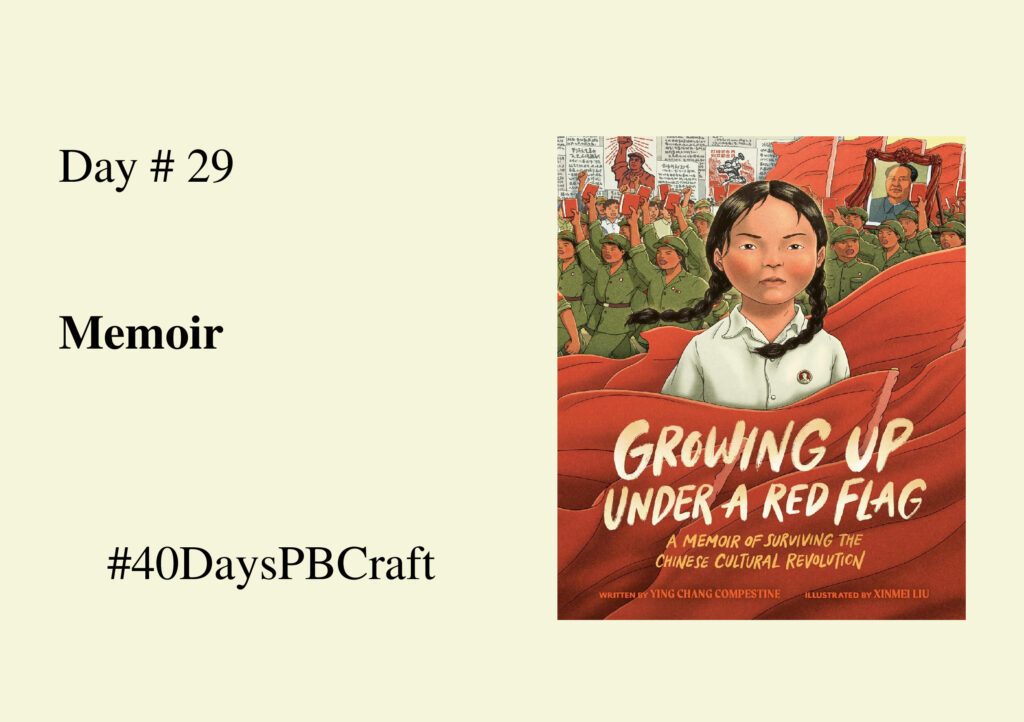
Growing Up under a Red Flag (2024, Ying Chang Compestine, Xinmei Liu) is a good book to study. The picture book brings us into a child’s world: to the time when Mao came to power, to when the author’s father had to burn books, to when she struggled in the crowd outside the market, to when her mother had to shave her hair because of lice, and to when her father was taken away.
What struck me is how the book shows these moments without overwhelming you. You feel the fear, the tension, and the small victories of the child, but it never becomes a history lecture. Every scene is chosen carefully—what to show, what to leave out. That’s exactly the skill we need when writing picture book memoirs.
Reading picture book memoirs makes you ask the right questions: Which parts of the story really matter? Which moments carry the emotion worth sharing? That’s why memoirs are such a good teacher.
Hint: A memoir isn’t an autobiography. An autobiography covers the author’s entire life, emphasizing facts and events. It’s comprehensive and chronological. Memoirs, on the other hand, focus on a specific period, theme, or set of experiences in the author’s life. They are selective rather than trying to cover everything.
Hope reading this blog post has given you new ideas. See you tomorrow for Day 30.