Welcome to day 27 of 40 craft lessons.
Math storytelling isn’t biographies of mathematicians. It also doesn’t refer to nonfiction books about math themes or math concept books. It’s exactly what the title implies: tell a story that familiarizes the young reader with math in a fun way.
That means the narrative structure (beginning–middle–end) should revolve around a math topic. Quite easy, isn’t it?
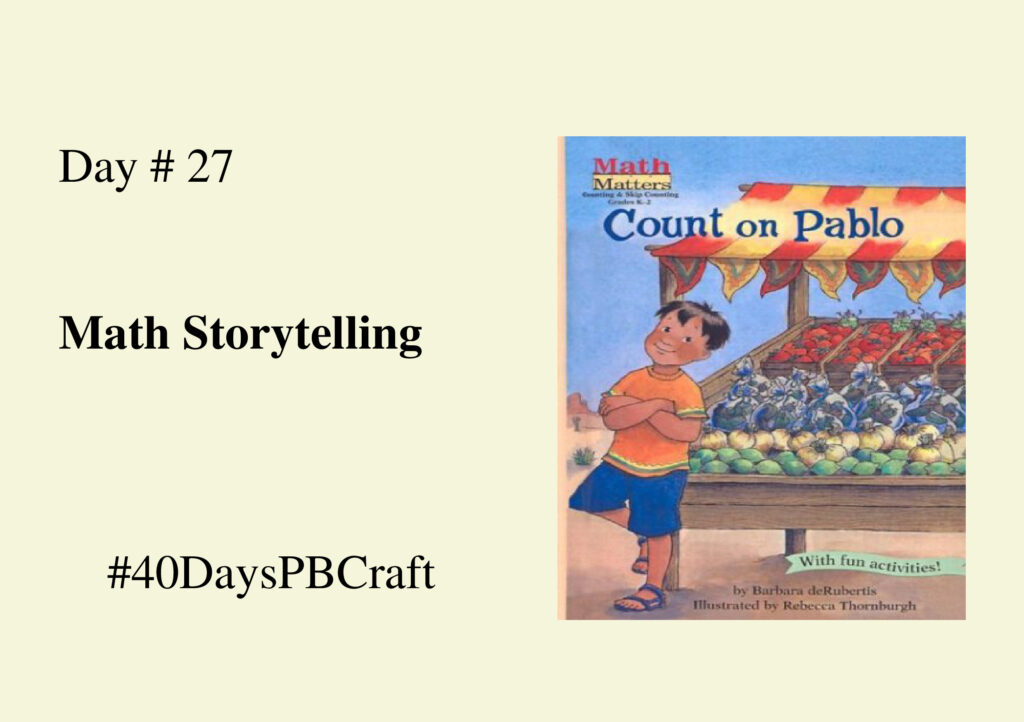
Among the existing series in the market, I think the Math Matters series has nailed this niche. For example, Count on Pablo (1999, Barbara deRubertis, Rebecca Thornburgh) is about a young boy, Pablo, and his grandmother. On market day, he helps his grandmother harvest vegetables, counting limes as he twists them off the tree. He ties onions in pairs, puts peppers in bags of five, and counts tomatoes by tens. Now, they are ready to drive to the market.
After waiting for hours at their stand, the grandmother and Pablo don’t sell anything. That’s the story’s lowest point. The character faces an obstacle that sucks. That’s exactly what we don’t see in some recent picture books, where the character’s way to the plot goal is paved with a red carpet!
Pablo is exhausted and hungry. He buys tortillas from another stand. Suddenly, he gets an idea: make and sell salsa. Pablo and his grandmother quickly make salsa from their products. Pablo advertises their sample salsa, and soon they are sold out!
Here’s where the story structure becomes clear. The market day marks the Inciting Incident; the preparation forms the Beginning; the lack of customers and tortilla purchases is the Middle; making salsa and finding customers creates the Climax; and the sold-out moment is the story’s Resolution. And this story teaches the young reader the counting chart.
Even if you don’t want to write math stories, reading these stories helps you practice identifying story elements.
Hope reading this blog post has given you new ideas. See you tomorrow for Day 28.