Welcome to day 26 of 40 craft lessons.
Picture books have dual narratives: text and illustration. Wordless picture books have only one narrative—illustration—which is a big advantage, especially for young readers who don’t need an adult to read the book aloud to them.
Most wordless picture books are created by the author-illustrator. However, I still believe reading those books benefits authors in honing their storytelling craft. Wordless picture books aren’t a collection of eye-catching illustrations; there should be a story like a thread that makes a necklace—a story with a narrative structure (beginning–middle–end), a character, and possibly even a character arc.
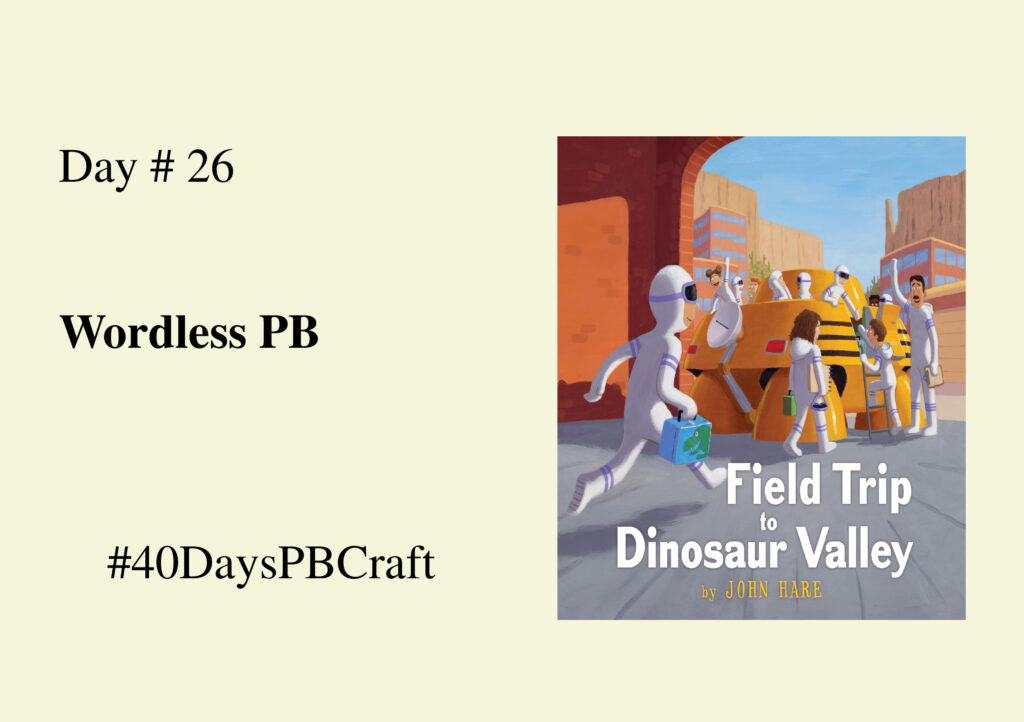
The Field Trip series by John Hare is a brilliant example that shows how a fantasy trip can become a wordless story. In the series, one student is always left behind, and the story focuses on that child. He shows no stress; instead, he befriends the animals or fantasy creatures around him until the teacher comes back to take him.
The series amazes me. Without saying even one word, we see the distinctive character of this child purely through his actions, while some not-wordless picture books have cookie-cutter characters.
The story follows a clear narrative structure. The inciting incident occurs when the student is left behind. His reactions to the environment make up the middle of the story, and the resolution comes when the teacher brings him safely back to the school bus.
If you want to trim words from your picture book manuscripts, studying wordless picture books can give you clues on how to let illustrations carry more of the story, rather than relying on text.
Hope reading this blog post has given you new ideas. See you tomorrow for Day 27.