Welcome to day 23 of 40 craft lessons.
High-concept books are like El Dorado: agents and publishers seek them, and writers love to write them. But what are they?
High-concept books are commercial, easily pitchable ideas with a unique twist that anyone can understand instantly. You can summarize a high-concept film or book with a simple “what-if” question that reveals the story’s twist. What if, for one person, tomorrow never comes? If that doesn’t sound familiar, watch the movie Groundhog Day (1993). Or: What if dinosaurs were brought back to life? (Jurassic Park, 1993.)
Coming up with a twist on a familiar idea isn’t the hard part—anyone can generate plenty of those. The real difficulty, and the reason good high-concept stories are so rare, is that the idea itself must carry the weight of the narrative for an entire movie or book, whether it’s 300 pages or a 40-page picture book.
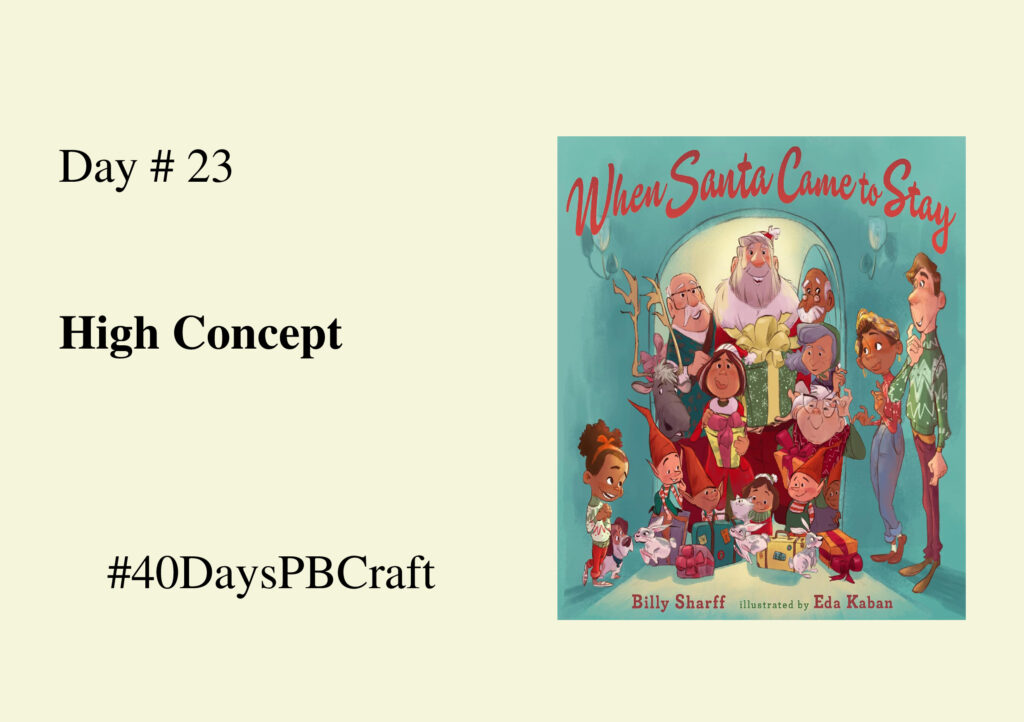
Take the idea behind When Santa Came to Stay (2022, Billy Sharff, Eda Kaban). To pitch the idea, you don’t need to explain who Santa is; that’s why it’s high-concept. It also has a twist: What if Santa overstays his welcome?
So, Santa stays. That fills one spread. What happens next? Now you see the challenge.
That’s the magic—and the challenge—of high-concept storytelling: the idea hooks us instantly, but it’s what comes after that truly makes the story.
Hint: Don’t confuse concept picture books with the high-concept ones.
I hope reading this blog post has given you new ideas. See you tomorrow for Day 24.