Welcome to day 21 of 40 craft lessons.
Another popular type of epistolary narration is a diary. The word ‘narration’ after epistolary reminds us of an important fact.
Many people actively do daily journaling. If we create a child character who does so, would the diary be a picture book, or would it be a list of “this happened” and “that happened”?
Without a clear story structure—beginning, middle, and end—those scribbles would just be a bunch of descriptions. Even if the diary notes include key events that could be considered an inciting incident, unless the story develops a proper middle and ending, it doesn’t really count as a full narration.
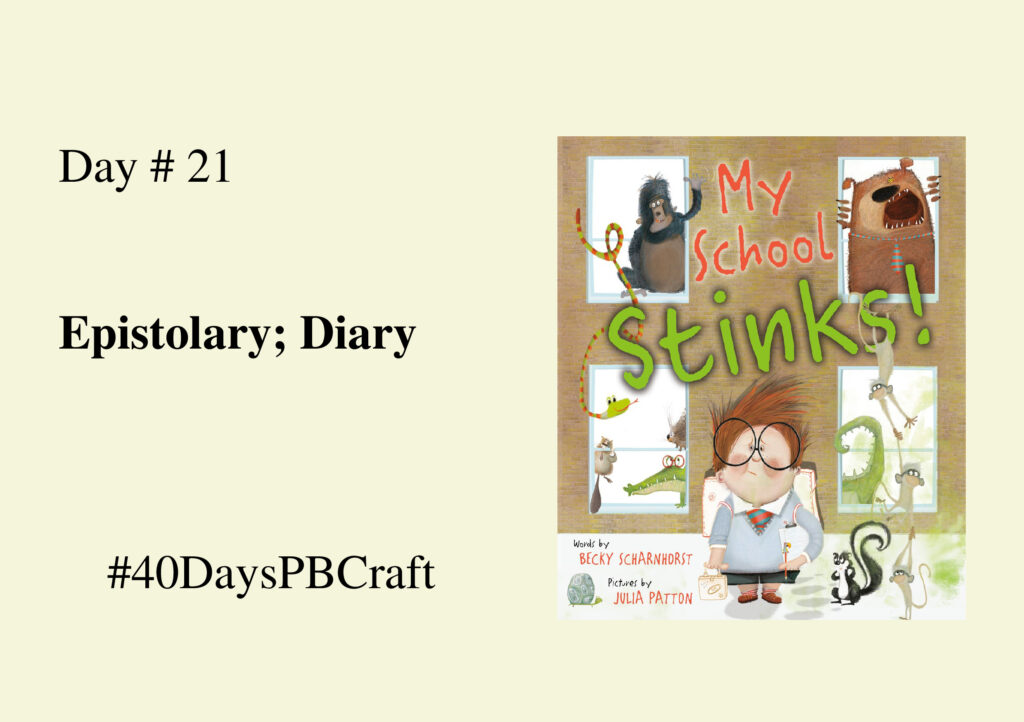
Let’s study My School Stinks! (2021, Becky Scharnhorst, Julia Patton). The inciting incident and the first diary entry occur on the first day of school—not an ordinary school, but one with real animal classmates. As we read entry after entry, we see the main character’s attitude change. The character arc starts with “My school stinks” and ends with “Things I love about WildWood Elementary.” In the illustration, we see the story’s resolution: the boy befriends his classmates!
Similar to letters—the other epistolary form we looked at before—a diary narration should have all the elements that make a story. The diary form is only the façade of the building; beneath it, the author should plot and construct a complete, stable building.
I hope reading this blog post has given you new ideas. See you tomorrow for Day 22.