Welcome to day 20 of 40 craft lessons.
Epistolary narration refers to any story told through written communication. For example, letters, diaries, or collections of documents such as postcards, emails, or text messages.
Many picture books that use diaries, postcards, or letters take a humorous approach. However, this type of narration can also be used to explore serious or complex topics—even political ones.
The point to keep in mind is that writing some letters in a row doesn’t make a story! I imagine this like baking. You can pour the batter into a heart-shaped mold (epistolary) or a square mold (simple text). In either case, you need the batter—the narrative structure, meaning beginning-middle-end.
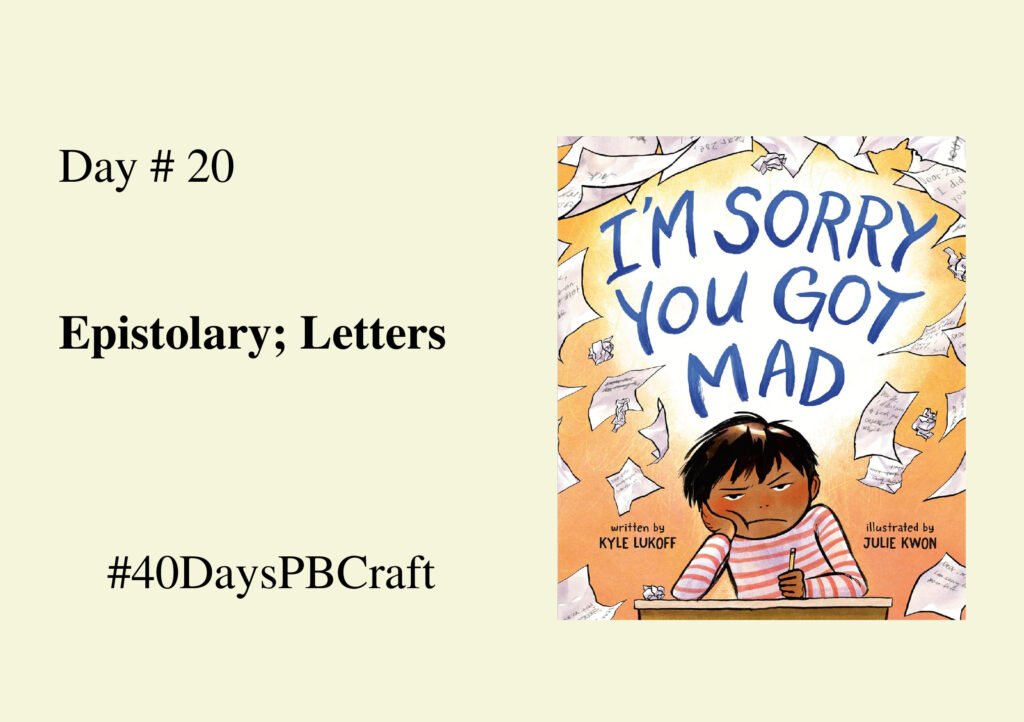
I’m Sorry You Got Mad (2024, Kyle Lukoff, Julie Kwon) tells a story entirely through letters that Jack writes to his classmate Zoe. The first letter has only one word: “Sorry.” As the story develops, the letters grow longer, and letter by letter, we learn what Jack is sorry for and see Jack’s attitude change.
The letters are short, but the story still delivers complete narration: the backstory (yesterday, Jack had destroyed Zoe’s castle), the character’s emotional growth (Jack learns to express his anger with words), the character arc (from thinking castles are only for girls to building a new castle together with Zoe), and, finally, the resolution—he befriends Zoe.
All those elements give the letters’ consequences a meaningful story. This shows that whether a story is told entirely through letters or a mix of letters and narration, it is the structure and character development that give it meaning and depth.
I hope reading this blog post has given you new ideas. See you tomorrow for Day 21.