Welcome to day 18 of 40 craft lessons.
Metaphor is another powerful asset in your writing toolbox. It allows you to convey complex emotions and ideas in the story without explicitly naming them.
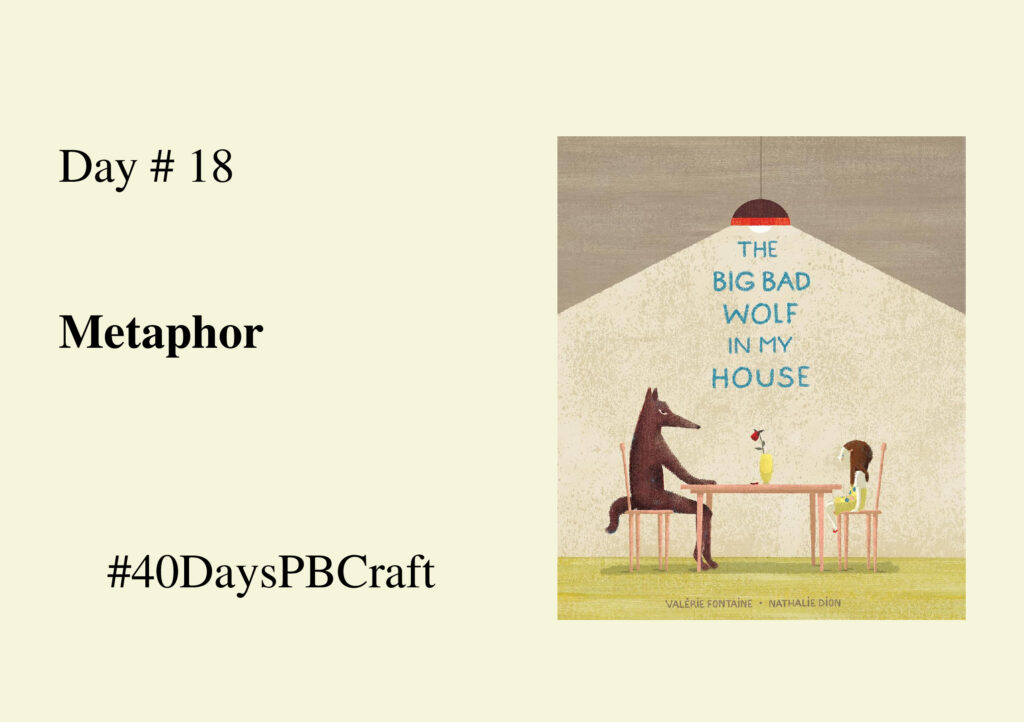
The Big Bad Wolf in My House (2021, Valérie Fontaine, Nathalie Dion, Shelley Tanaka) is a story about a heart-wrenching topic: child abuse. Until I read it, I had never imagined that writing about it for young readers, as a picture book, could be possible.
In this story, the mother’s boyfriend is depicted both literally and illustratively as a wolf—a big, bad wolf. The story immerses us in the child’s world, as she imagines the wolf looking at her with cold eyes and sharp teeth, when the wolf leaves finger marks on her arm, and when she closes her eyes, even on the day when the sun is out.
If you look at the picture book market, you’ll see that picture books like this are extremely rare. One reason, of course, is the business side: publishers tend to earn more from books about holidays or happy families with cute children. But beyond that, I believe creating a story like this requires a high level of storytelling craft, which makes such books especially rare and remarkable.
Hint: Metaphor is not a simile. A metaphor compares things implicitly, whereas a simile does so explicitly, using ‘like’, ‘as … as’, or ‘as’.
I hope reading this blog post has given you new ideas. See you tomorrow for Day 19.